
Two big ways that students waste time while studying for exams
Just like a day at the office, it's possible for a high school student to be busy for hours and get absolutely nothing done. Today we're going to go through two really important parts of the study process and why many students waste so much time doing them wrong.
Practice alone does not guarantee results
Imagine that you want to learn kung fu. You spend five years watching Bruce Lee movies and imitating his moves. Are you a kung fu master yet? No, because you didn't spend five years practising kung fu; you spent five years practising punching the air and making Bruce Lee noises (which you should be pretty good at by now). Practice makes perfect, but what exactly are you practising?
In the lead-up to exams, most students sitting Cambridge and NCEA will be going through a lot of past exam papers (something we wholeheartedly recommend). However, we notice that many will just set themselves a quota—e.g., one past paper a day—without considering what they're actually learning.
You do the paper, skip some questions, get others wrong, aaaaand you're done—that's your study for the day. What did you learn? You're getting some questions right—great, that's good practice. However, if you don't spend some time figuring out what you got wrong or how to do the questions you skipped, you're not really improving in those areas—all you're doing is practising how to get those types of questions wrong and how to skip questions.
If you mindlessly go through past paper after past paper without learning from your mistakes, your grades will not improve. The line defining insanity as “doing the same thing over and over and expecting different results” is often attributed to Einstein, but there is no reliable evidence that he said it. The useful point is simpler: repeating an ineffective process will not magically make it effective.
Instead, we find that students improve fastest when they continuously self-correct. Practise what you understand and identify what you do not. Build a sound grasp of each core idea, then revisit and mix topics so you also learn to recognise which method a new question requires.
Do this by:
- Look through your notes
- Look at worked examples/answers
- Ask your teachers
- Get help from a private tutor
- Discuss it with your friends
Most students will do a bit of the above, and watch their grades creep up gradually, but if you want a big boost then you need to make an active effort to address your weaknesses.
Lesson #1: If you practise doing things the wrong way, you'll become very good at doing them the wrong way.
Forgetting things is a waste of time
Just because you understand something, it doesn't mean your job is done. In our experience, a major thing that limits the progress of students is the lack of follow-up.
A student will often be really engaged in a lesson, follow everything quite well, and improve their understanding tremendously. One week later, they may struggle to retrieve much of it and need to go over it again. This really hinders momentum and wastes a lot of time.
After finally understanding all these new things that confused you before, it's sometimes hard to have the motivation to do that extra bit of practice - you feel like you're past the finish line already and you don't have the energy.
But let's take a moment to pretend that you're not learning something new, but instead you're biking up a hill.
The professionally drawn diagram below illustrates the choice you have. You've done all the hard work climbing up the hill and you're finally at the top. Are you going to stop pedalling and roll back down the hill, or are you going to spend that tiny extra bit of energy to get yourself onto the flat ground?
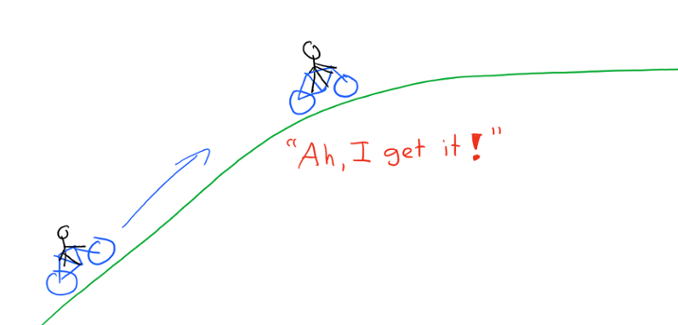
Similarly, why don't you just spend a little more effort making sure you remember what you've just learned rather than letting that knowledge slip away? You wouldn't roll down that hill and then pedal back up, so why would you let yourself forget and relearn things later?
If it's a maths concept, do questions on that concept. If it's an essay technique, practise using that technique. Make sure you're so familiar with it that when you encounter a similar but different question in the exam you will still be able to apply the same concepts.
Get yourself onto that flat ground: follow up while the idea is fresh, then retrieve it again after increasing gaps. You will still forget some things, but spaced retrieval makes later relearning much easier. There's a life lesson in there somewhere too.
Lesson #2: Going over something you just learned takes much less time than relearning it later.
You need both
No amount of practice is going to help if you don't know what you're doing, and no amount of amazing explanations is going to help if you don't practise on your own. Overdoing one thing while neglecting the other will often give you the illusion that you're studying, when in reality you're not really improving. Both components are closely related, and both are needed if you want to improve.
Article by Jimmy Li
Jimmy is the co-founder of MyTuition. MyTuition helps high school students across New Zealand succeed by connecting them with the right tutors and guiding them through the year.
Have more questions? You can get in touch with Jimmy at team@mytuition.nz